
Federal judges block Connecticut and California rules on masked ICE agents
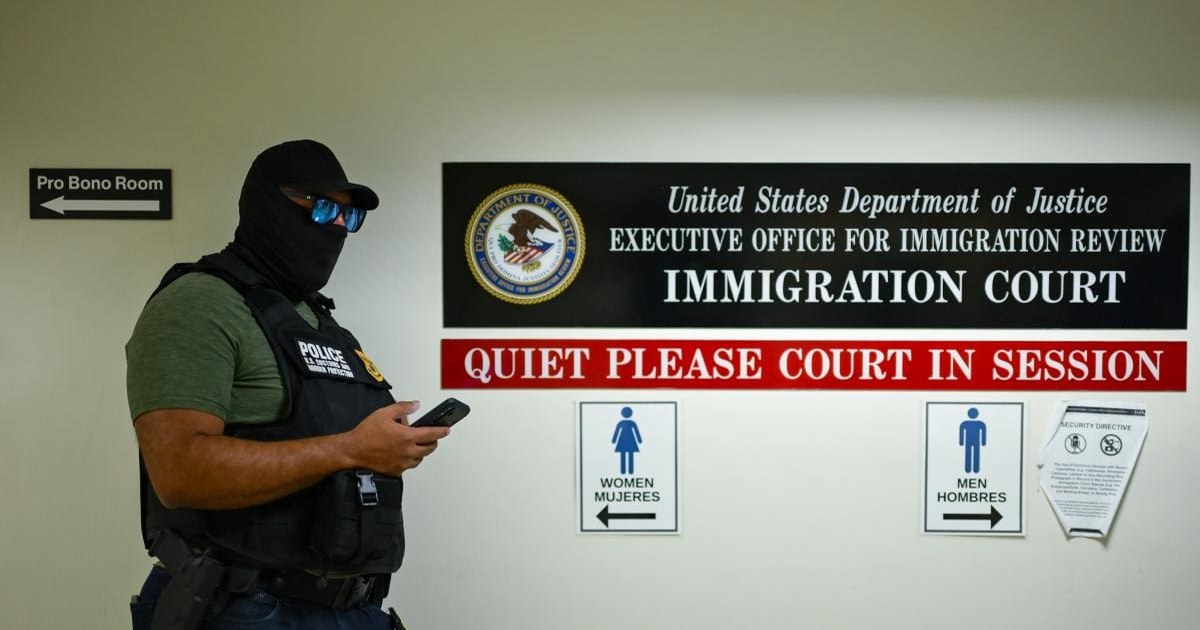 Photo: Getty Images (file photo)
A federal judge in Connecticut on Friday blocked the state from enforcing a law that would have barred federal immigration agents from wearing masks and required them to show identification — the second such ruling against a Democratic-led state in four days, after a California court permanently struck down similar rules on Tuesday.
U.S. District Judge Vernon D. Oliver issued a preliminary injunction blocking four sections of Connecticut's S.B. 397, a law passed by state Democratic lawmakers and signed by Gov. Ned Lamont in May, ruling that the provisions likely violate the Supremacy Clause of the U.S. Constitution and that the Justice Department is likely to win the lawsuit it filed in May.
Three of the blocked sections would have applied Connecticut's use-of-force standards to federal officers and empowered the state's Inspector General to investigate and criminally prosecute federal agents, including in cases where their use of force killed someone. The fourth would have made it a misdemeanor for officers to wear a face covering while interacting with the public, and required them to display visible badges and name tags during certain planned arrests.
"The federal government's sovereignty is supreme, so no state government can exclude the federal government from the exercise of any authority conferred upon it by the Constitution or obstruct its authorized officers against its will," Oliver wrote in a 39-page order. He said the state law "plainly imposes conditions on how federal officers must conduct and present themselves during the course of their federal duties, and it subjects them to criminal and civil penalties if they do not abide by those state-imposed conditions."
The injunction is preliminary, not a final judgment, and the case continues. The order bars the state, the governor and the state's chief prosecutor from enforcing the four sections against federal officers. Attorney General William Tong was dismissed from the case because the judge found his office has only civil authority and could not prosecute the law's criminal provisions.
The ruling is a significant setback for Connecticut Democrats, who passed the law to rein in ICE agents after enforcement stepped up sharply across the country. Masked ICE agents made an arrest at a courthouse in Meriden in September, raising questions about the law and whether agents were acting beyond their authority.
"We are disappointed by today's ruling and condemn ICE's treatment of Connecticut residents," Cathryn Vaulman, Lamont's communications director, said Friday. "Masked, armed agents without visible badges have surrounded cars in traffic and stormed homes and workplaces, rounded up parents dropping kids off at school and picked up a Cheshire high school student whose father aided troops in Afghanistan."
State Rep. Steven Stafstrom of Bridgeport, a key backer of the law, said he feared the ruling "leaves Connecticut less safe, because it blocks the tools S.B. 397 gave us to investigate deaths involving federal officers and to make sure people know who is exercising police power in our communities." He stressed that the ruling is preliminary and said he would work with the attorney general's office on next steps.
Republican lawmakers in Connecticut celebrated the decision, saying they had warned their Democratic colleagues that the law violated the Supremacy Clause. "We warned that the law violates the Constitution's Supremacy Clause by attempting to regulate federal officers while they carry out their official duties," said a statement from Sen. Rob Sampson, Sen. Eric Berthel and outgoing Senate Minority Leader Stephen Harding.
Three days earlier, in California, U.S. District Judge Christina A. Snyder signed a permanent injunction barring the state from enforcing two similar laws — S.B. 627, the "No Secret Police Act," which made it a crime for officers to wear a face covering that hides their identity on duty, and S.B. 805, the "No Vigilantes Act," which required officers out of uniform to display their agency and a name or badge number. California agreed to end the case, and it was dismissed with prejudice, meaning the same claims cannot be brought again.
The California order followed an October 14 ruling by the 9th U.S. Circuit Court of Appeals, which held that the identification law violated the Constitution's Supremacy Clause by trying to directly regulate the federal government as it carries out its own functions. "Today's permanent injunction confirms a basic constitutional principle: states do not have the authority to regulate the Federal Government or dictate how federal law enforcement officers perform their official duties," Associate Attorney General Stanley E. Woodward Jr. said when the Justice Department announced the result on Thursday.
Sources: CT Mirror (via The Bristol Edition), "Federal judge blocks CT law that sought to regulate ICE agents" (Nov. 20, 2026, full text verified); Hartford Courant (via Police1), "Federal court blocks enforcement of Connecticut law regulating ICE agents" (Nov. 20, 2026, full text verified); New York Post, "California agrees to stop enforcing mask law for ICE agents" (Nov. 19, 2026, search result verified); Newsmax, "Judge Blocks California Mask Ban for Federal Agents" (Nov. 19, 2026, search result verified). Event dates verified: the Connecticut ruling was issued Friday, November 20, 2026; the California order was signed Tuesday, November 17, 2026.
Sponsored